
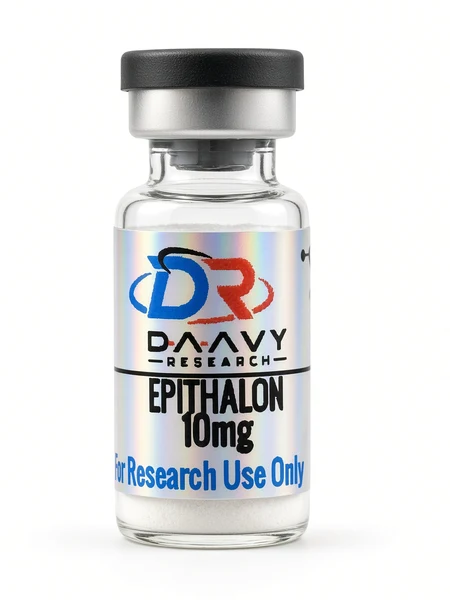
1. What Epithalon is
Epithalon (also written Epitalon; sequence Ala-Glu-Asp-Gly, "AEDG") is a synthetic tetrapeptide with a molecular weight around 390 Da. It was developed at the St. Petersburg Institute of Bioregulation and Gerontology by Vladimir Khavinson's research group as a defined synthetic analog of epithalamin, a polypeptide complex originally extracted from bovine pineal gland tissue. Epithalon and epithalamin are related but not identical — a distinction that matters when reading the literature, since some of the most-cited human data was collected using epithalamin, not the synthetic tetrapeptide sold as a research compound today. It is typically supplied as a lyophilized powder for laboratory use, code-labeled by milligram amount.
2. What research has studied
The foundational published claim for Epithalon comes from a 2003 study by Khavinson, Bondarev, and Butyugov in the Bulletin of Experimental Biology and Medicine, which reported that Epithalon induced expression of the telomerase catalytic subunit (hTERT) and produced measurable telomere elongation in telomerase-negative human fetal fibroblast cultures — extending their replicative capacity well beyond the untreated controls' division limit. A 2004 follow-up in the same journal, using human fetal pulmonary fibroblasts, reported additional cell-division passages in treated cultures compared to controls.
For roughly two decades, this line of evidence came almost entirely from Khavinson's own institute. That changed in 2025, when an independent research group at Brunel University London — with no affiliation to Khavinson — published a study in Biogerontology examining Epithalon in normal human breast epithelial cells, fibroblasts, and breast-cancer cell lines. The study reported dose-dependent telomere extension in the normal cells through hTERT expression and telomerase upregulation, corroborating the original mechanism in an independent lab for the first time. Notably, the cancer cell lines in the same study showed telomere extension through a different pathway — alternative lengthening of telomeres (ALT) — rather than telomerase activation, indicating the mechanism is not uniform across all cell types.
3. What this research does not establish
- The human longevity and cardiovascular-aging data frequently cited for Epithalon largely used epithalamin — the original bovine pineal extract — not the synthetic AEDG tetrapeptide research vials are sold as. Those findings do not automatically transfer between the two.
- No completed, placebo-controlled human trial has measured telomere length in living people before and after Epithalon administration. The telomerase and telomere-elongation evidence, including the 2025 replication, is entirely from cell cultures in a dish.
- Cell-culture telomere extension does not equate to slower aging in a living organism. Cultured cells aren't subject to immune surveillance, hormonal regulation, or the systemic processes that drive aging in the body.
- Most of the published record originates from a single institute with a commercial and patent interest in the compound, which is why the 2025 independent replication is a meaningful addition — but it confirms only the in-vitro mechanism, not the broader human-longevity claims built on top of it.
4. What an Epithalon Certificate of Analysis verifies
Because Epithalon is a very short, small-molecular-weight peptide, the analytical questions a COA should answer are the same as for any research peptide: does the vial contain the labeled sequence (identity, typically via LC-MS/MS), how much is present relative to the labeled amount (content, via HPLC quantitation), and how pure is the sample (overall purity, via RP-HPLC). See the Interactive COA Decoder for a field-by-field walkthrough and red-flag checklist, and the How to Read a COA guide for the fundamentals. DAAVY Research's current Epithalon listing, with price, stock, and Certificate of Analysis, is at Epithalon 10 mg.
Sources
- Khavinson, Bondarev & Butyugov (2003), "Peptide Promotes Overcoming of the Division Limit in Human Somatic Cells" — Bulletin of Experimental Biology and Medicine, PubMed
- Khavinson et al. (2004) follow-up fibroblast passage study — Bulletin of Experimental Biology and Medicine, PubMed
- Al-Dulaimi, Thomas, et al. (2025), independent replication study — Biogerontology, PubMed
Research-use disclaimer
This page summarizes published research for educational purposes. It has not been evaluated by the U.S. Food and Drug Administration. DAAVY Research supplies Epithalon only for legitimate laboratory, analytical, academic, or institutional research; it is not intended for human or veterinary use, consumption, diagnosis, treatment, or prevention. Nothing on this page is dosing, medical, or legal advice. See our complete research-use policy.