1. What NAD+ is
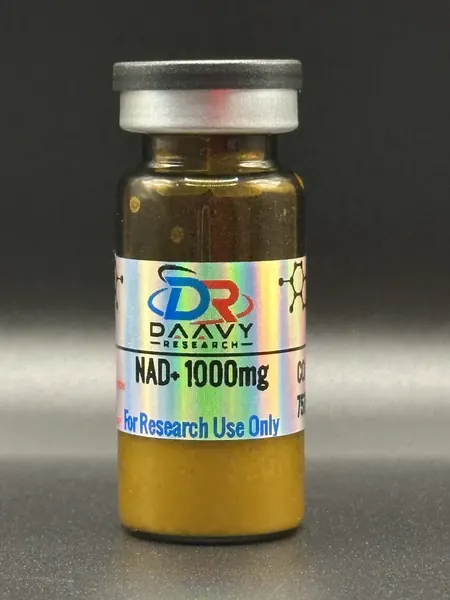
Nicotinamide adenine dinucleotide (NAD+) is an essential redox coenzyme present in every living cell, existing in oxidized (NAD+) and reduced (NADH) forms. It functions as a hydride-electron carrier in core metabolic processes including oxidative phosphorylation and ATP production, and participates in DNA repair, calcium-dependent signaling, and gene expression. Cellular NAD+ levels are reported to decline with age. It is typically supplied as a lyophilized powder for laboratory use, code-labeled by milligram amount.
2. What research has studied
A 2026 PRISMA-guided systematic review published in Ageing Research Reviews (ScienceDirect) searched peer-reviewed human and rodent intervention studies from January 2010 through October 2025 and identified 113 eligible studies — 33 human intervention studies (28 randomized) and 80 rodent studies — evaluating NAD-related compounds administered orally or parenterally. The review reported that rodent studies frequently showed improvements in metabolic, mitochondrial, inflammatory, and functional outcomes following NAD+ augmentation, though effects varied across models and endpoints, while human studies of oral precursors consistently demonstrated measurable increases in circulating or cellular NAD-related metabolites.
Mechanistically, a 2025 review in Nutrients by Yu and colleagues described NAD+'s role in activating the sirtuin deacetylase family (SIRT1, SIRT3), which regulates mitochondrial biogenesis and antioxidant defenses, and in promoting mitochondrial autophagy to clear damaged mitochondria — processes studied in the context of mitochondrial dysfunction and heart failure models. A systematic review of randomized controlled trials published in the American Journal of Physiology-Endocrinology and Metabolism specifically evaluated the safety and effectiveness of NAD+ and NADH (as distinct from precursor compounds) across multiple clinical conditions using a formal risk-of-bias assessment.
3. What this research does not establish
- Most "NAD+-boosting" human trials study precursor compounds (nicotinamide riboside or nicotinamide mononucleotide), not direct NAD+ administration — a meaningfully different intervention with a separate evidence base.
- Demonstrating a biochemical effect is not the same as demonstrating a clinical benefit. A 2024 review in Science Advances examining 25 published human nicotinamide riboside studies concluded that oral supplementation displayed few clinically relevant effects overall, and specifically noted a tendency in the literature to overstate the robustness and importance of reported findings.
- Rodent-model results do not automatically apply to humans. The 2026 systematic review noted that rodent outcome improvements varied substantially across different models and endpoints even within animal studies.
- Direct NAD+ administration and indirect precursor supplementation raise different questions — including delivery, bioavailability, and which tissues actually see elevated NAD+ levels — that are not identical between approaches.
4. What an NAD+ Certificate of Analysis verifies
Because NAD+ is supplied as a lyophilized powder, the analytical questions a COA should answer are: does the vial contain NAD+ specifically as opposed to a related precursor or degradation product (identity, typically via LC-MS/MS), how much is present relative to the labeled amount (content, via HPLC quantitation), and how pure is the sample (overall purity, via RP-HPLC). See the Interactive COA Decoder for a field-by-field walkthrough and red-flag checklist, and the How to Read a COA guide for the fundamentals.
Sources
- "NAD+ supplementation for anti-aging and wellness: A PRISMA-guided systematic review of preclinical and clinical evidence" (2026), Ageing Research Reviews — ScienceDirect
- "Evaluation of safety and effectiveness of NAD in different clinical conditions: a systematic review," American Journal of Physiology-Endocrinology and Metabolism
- Yu et al. (2025), "Nicotinamide Adenine Dinucleotide Supplementation to Alleviate Heart Failure: A Mitochondrial Dysfunction Perspective," Nutrients — PMC
- "What is really known about the effects of nicotinamide riboside supplementation in humans," Science Advances
Research-use disclaimer
This page summarizes published research for educational purposes. It has not been evaluated by the U.S. Food and Drug Administration. DAAVY Research supplies NAD+ only for legitimate laboratory, analytical, academic, or institutional research; it is not intended for human or veterinary use, consumption, diagnosis, treatment, or prevention. Nothing on this page is dosing, medical, or legal advice. See our complete research-use policy.