1. What Glutathione is
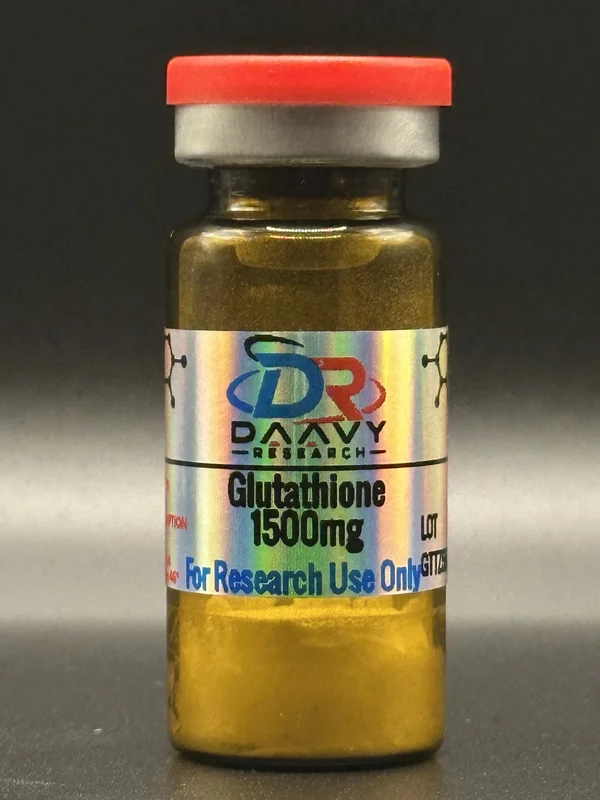
Glutathione (GSH) is a naturally occurring tripeptide composed of glutamate, cysteine, and glycine (γ-glutamyl-cysteinyl-glycine), synthesized endogenously in nearly all human cells. It is typically supplied here as a lyophilized (freeze-dried) powder for laboratory use, code-labeled by milligram amount.
2. What preclinical and biochemical research has studied
A 2014 review in Frontiers in Pharmacology by Aquilano, Baldelli, and Ciriolo described glutathione's central role in cellular redox signaling — beyond simple free-radical scavenging, the review detailed how the reduced (GSH) and oxidized (GSSG) forms interconvert to modulate nitroxidative stress, autophagy, and cellular responses to viral infection. The review noted that healthy cells typically maintain a GSH-to-GSSG ratio of roughly 100:1 or higher under normal physiological conditions.
A 2014 editorial in Integrative Medicine: A Clinician's Journal by Pizzorno summarized glutathione's role across detoxification, mitochondrial function, and cellular aging research, describing it as one of the most abundant intracellular molecules involved in maintaining redox homeostasis, alongside its function as a cofactor for glutathione peroxidase and its role in recycling other antioxidants.
3. What this research does not establish
- This listing is a research-grade lyophilized powder, not a clinical IV or oral formulation. Published research on glutathione's biological roles spans endogenous biochemistry and a range of clinically-administered formulations; none of that literature evaluates this specific research-material listing.
- No controlled human trials are cited here evaluating exogenous supplementation outcomes. The sources above describe glutathione's endogenous biochemical roles and redox biology, not a demonstrated clinical benefit from external administration.
- Route, dose, and formulation substantially affect bioavailability in the broader literature on glutathione administration — findings from one formulation or route do not generalize to another.
4. What a Glutathione Certificate of Analysis verifies
Because Glutathione is supplied as a lyophilized powder, the analytical questions a COA should answer are: does the vial contain the labeled tripeptide (identity, typically via LC-MS/MS), how much is present relative to the labeled amount (content, via HPLC quantitation), and how pure is the sample (overall purity, via RP-HPLC). See the Interactive COA Decoder for a field-by-field walkthrough and red-flag checklist, and the How to Read a COA guide for the fundamentals.
Sources
Research-use disclaimer
This page summarizes published literature for educational purposes. It has not been evaluated by the U.S. Food and Drug Administration. DAAVY Research supplies Glutathione only for legitimate laboratory, analytical, academic, or institutional research; it is not intended for human or veterinary use, consumption, diagnosis, treatment, or prevention. Nothing on this page is dosing, medical, or legal advice. See our complete research-use policy.