For Research Use Only. Everything on this site is intended solely for laboratory, analytical, or institutional research — not for human or veterinary use, consumption, diagnosis, treatment, or prevention.
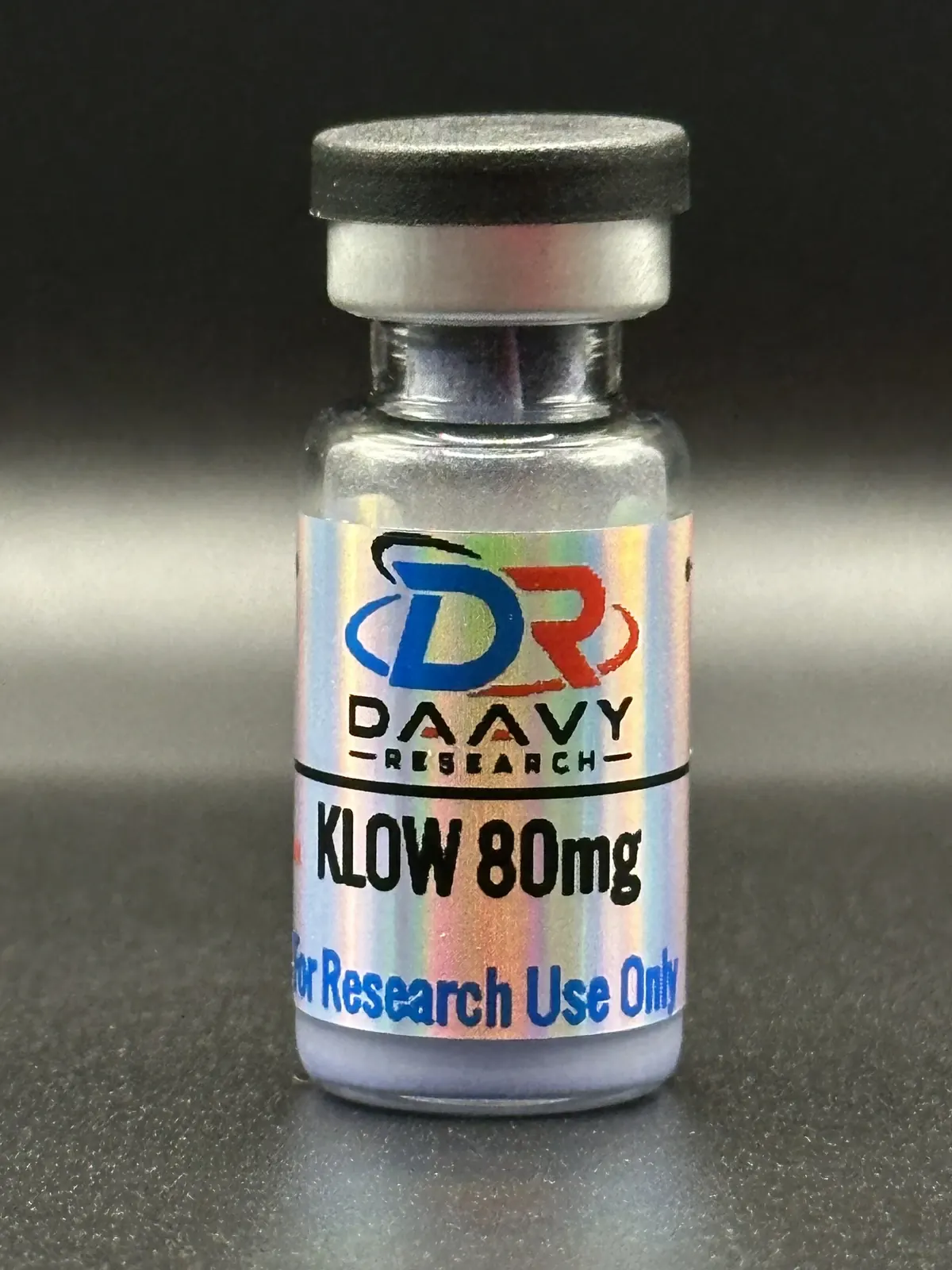
This page documents the current DAAVY Research KLOW listing, including its component formulation, labeled amount, price, availability, and analytical-document status. No human-use claims are added.
KLOW is listed as a code-labeled, lyophilized laboratory research material combining four peptide components at a total labeled amount of 80 mg: GHK-Cu 50 mg, BPC-157 10 mg, TB-500 10 mg, and KPV 10 mg. The catalog name, per-component amounts, and current lot documentation should be confirmed before placing an order request.
Research background
KLOW combines four peptide components, each separately represented in the published research literature. GHK-Cu is a copper-binding tripeptide studied for tissue remodeling, collagen and elastin synthesis, and wound-healing models. BPC-157 is a synthetic pentadecapeptide evaluated in animal models for gastrointestinal tissue repair, tendon and ligament healing, and angiogenesis. TB-500 is a synthetic fragment of the protein thymosin beta-4, studied preclinically for its role in actin regulation, cell migration, and tissue and wound-repair models. KPV is a tripeptide corresponding to the C-terminal sequence of alpha-melanocyte-stimulating hormone (alpha-MSH), evaluated preclinically for anti-inflammatory and antimicrobial activity. For a sourced, component-by-component summary, see the KLOW Blend Research Overview. This page does not attribute published research findings to KLOW as a combined formulation — no study of this specific four-component combination is cited or implied, and researchers should independently review the literature on each named constituent before drawing conclusions about this material. This catalog listing has not been evaluated for the purposes described in this research. DAAVY Research supplies this material only for legitimate laboratory, analytical, academic, or institutional research; it is not intended for human or veterinary use, consumption, diagnosis, treatment, or prevention.
Analytical documentation
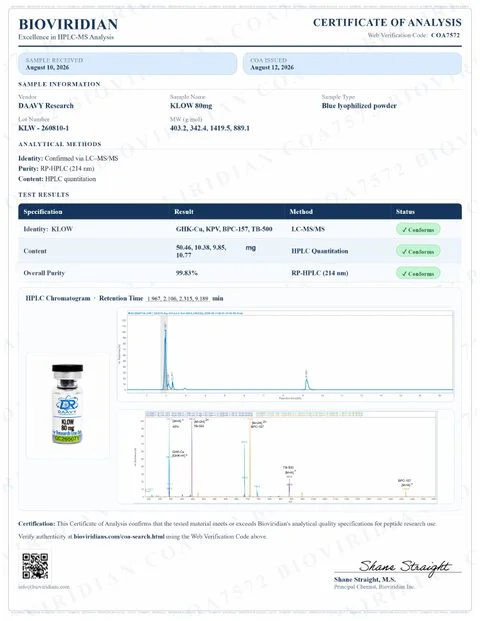
Third-party COA7572 identifies the KLOW 80 mg sample and records identity, component content, and overall purity testing by Bioviridians.
Molecular reference
GHK-Cu
50.46 mg tested · MW 403.2 g/mol (COA7572)
KPV
10.38 mg tested · MW 342.4 g/mol (COA7572)
BPC-157
9.85 mg tested · MW 1419.5 g/mol (COA7572)
TB-500
10.77 mg tested · MW 889.1 g/mol (COA7572)
Overall purity (COA7572)
99.83% by RP-HPLC (214 nm)
Identity method
LC-MS/MS, four-component confirmation
Component weights and molecular weights are as reported on COA7572 for this specific tested lot; values are provided for research identification purposes only.
Research-use controls
This material is supplied only for legitimate laboratory, analytical, academic, or institutional research. It is not intended for human or veterinary use or consumption, diagnosis, treatment, or prevention.
Frequently asked questions
What does the Certificate of Analysis for KLOW cover?
COA7572 documents the identity and analytical testing results reported for this specific tested lot. Review the full report and see our How to Read a COA guide for what each field means before relying on it.
Does ordering more than one vial lower the price?
Yes. KLOW uses the same tiered volume pricing as the rest of the catalog: 3–5 vials get 5% off and 6+ vials get 10% off, applied automatically in the cart — no code needed.
Is KLOW intended for human use?
No. KLOW is supplied strictly for laboratory, academic, institutional, or qualified independent research use. It is not for human or veterinary use, consumption, diagnosis, treatment, or prevention.