
1. What CJC-1295 and Ipamorelin are
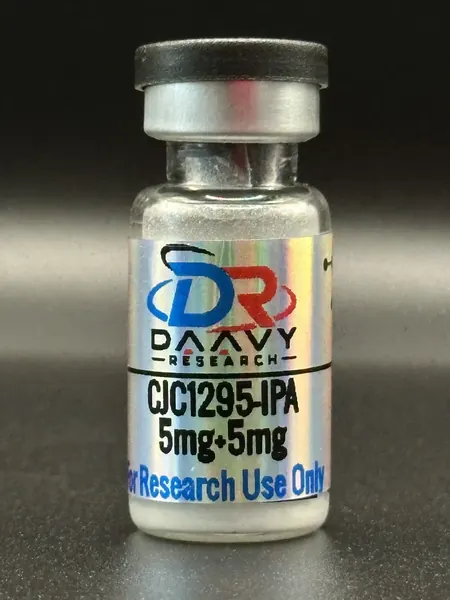
CJC-1295 is a synthetic analog of growth hormone-releasing hormone (GHRH), the hypothalamic peptide that signals the pituitary to release growth hormone. It is sold in two pharmacologically distinct forms: CJC-1295 with Drug Affinity Complex (DAC), a modification that binds the peptide to circulating albumin and extends its half-life to roughly 6-8 days, and CJC-1295 without DAC (also called Modified GRF 1-29), a short-acting form with a half-life closer to 30 minutes. DAAVY Research's Certificate of Analysis for this listing identifies the CJC-1295 component specifically as the without-DAC form. Ipamorelin is a synthetic pentapeptide that acts as a selective agonist of the ghrelin receptor (GHS-R1a), a separate GH-release pathway from GHRH. Both are supplied here as a two-component lyophilized (freeze-dried) powder.
2. What published research has studied
A 2006 study by Teichman and colleagues, published in the Journal of Clinical Endocrinology & Metabolism, is the only published human trial of CJC-1295 in either form. That trial evaluated the long-acting, albumin-binding CJC-1295 with DAC form specifically — not the without-DAC form identified on this listing's Certificate of Analysis. This page does not restate the trial's dosing or outcome figures; consult the primary source directly (linked in Sources below).
Ipamorelin was first characterized by Raun and colleagues in a 1998 paper in the European Journal of Endocrinology, using in vitro rat pituitary cell cultures and in vivo rat and swine models. The paper described a receptor pathway distinct from GHRH. This characterization was preclinical; it did not include a controlled human efficacy trial.
No published, completed controlled human trial has evaluated CJC-1295 and Ipamorelin administered together as a combination, in either compound's form.
3. What this research does not establish
- The published human trial does not describe the form of CJC-1295 in this listing. Teichman et al. (2006) studied CJC-1295 with DAC, the long-acting form. This listing's COA identifies its CJC-1295 component as the without-DAC (short-acting) form, which has no published human pharmacokinetic or efficacy trial of its own — its shorter half-life makes its dosing profile pharmacologically distinct from the studied form.
- No completed controlled human trial of the CJC-1295 + Ipamorelin combination exists. Everything published studies one compound at a time; combining them is not itself something the cited research has tested.
- Ipamorelin's characterization is preclinical. Its GH-release selectivity was demonstrated in rat and swine models and in vitro cell cultures, not in a controlled human efficacy trial.
- CJC-1295's clinical development history includes an unresolved safety event. A Phase 2 trial of CJC-1295 (with DAC) in HIV-associated visceral obesity (ClinicalTrials.gov NCT00267527, 192 participants) was terminated in 2006 after a participant death; contemporaneous reporting noted the cause and its relationship to the study drug were under investigation at the time, and no efficacy results from that trial were ever published. This does not establish that CJC-1295 caused the death, but the trial's termination and the absence of published Phase 2 data are part of the compound's documented research record.
- Animal-model and healthy-adult trial findings do not automatically apply to other populations or to real-world use patterns.
4. What this listing's Certificate of Analysis verifies
Because this is a two-component synthetic peptide product supplied as a lyophilized powder, its COA should independently address both components: does the vial contain the labeled peptides (identity, typically via LC-MS/MS), how much of each is present relative to the labeled amount (content, via HPLC quantitation), and how pure is each component (purity, via RP-HPLC). See the Interactive COA Decoder for a field-by-field walkthrough and red-flag checklist, and the How to Read a COA guide for the fundamentals. For a side-by-side look at how the two compounds differ mechanistically, see the CJC-1295 vs. Ipamorelin guide.
Sources
- Teichman et al. (2006), "Prolonged Stimulation of Growth Hormone (GH) and Insulin-Like Growth Factor I Secretion by CJC-1295, a Long-Acting Analog of GH-Releasing Hormone, in Healthy Adults," Journal of Clinical Endocrinology & Metabolism — PubMed
- Raun et al. (1998), "Ipamorelin, the First Selective Growth Hormone Secretagogue," European Journal of Endocrinology — PubMed
- ClinicalTrials.gov NCT00267527, "A Study to Evaluate CJC 1295 in HIV Patients With Visceral Obesity" (Terminated)
- aidsmap (2006), "Lipodystrophy Study Halted After Patient Death"
Research-use disclaimer
This page summarizes published literature for educational purposes. It has not been evaluated by the U.S. Food and Drug Administration. DAAVY Research supplies CJC-1295 + Ipamorelin only for legitimate laboratory, analytical, academic, or institutional research; it is not intended for human or veterinary use, consumption, diagnosis, treatment, or prevention. Nothing on this page is dosing, medical, or legal advice. See our complete research-use policy.