
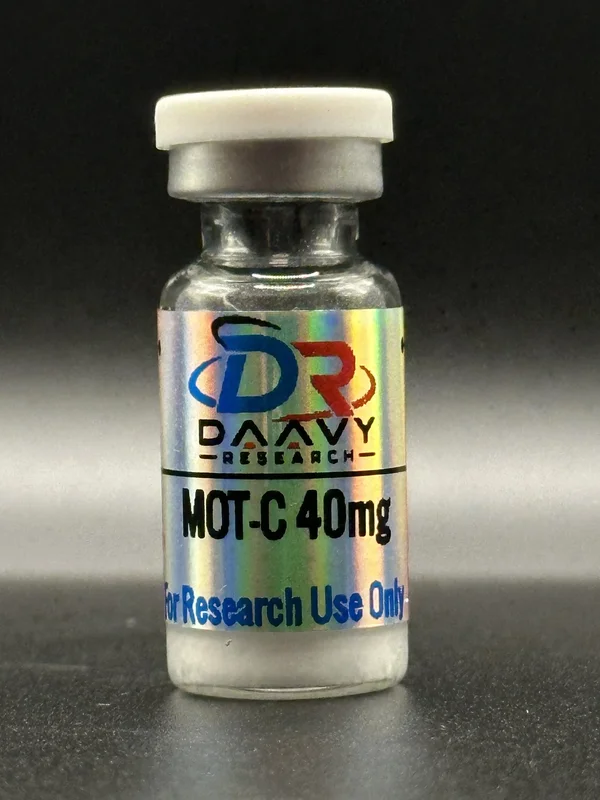
1. What MOTS-C is
MOTS-C (Mitochondrial Open reading frame of the 12S rRNA type-c) is a 16-amino-acid peptide encoded within a short open reading frame nested inside the mitochondrial genome's 12S rRNA region, rather than the nuclear genome like most peptides. It is typically supplied here as a lyophilized (freeze-dried) powder for laboratory use, code-labeled by milligram amount.
2. What preclinical research has studied
The peptide was first characterized in a 2015 study published in Cell Metabolism by Lee, Zeng, Drew, and colleagues, who reported that MOTS-C regulates insulin sensitivity and metabolic homeostasis in animal models, in part by inhibiting the folate cycle and its associated purine biosynthesis pathway, leading to activation of AMPK (a central cellular energy-sensing enzyme). In that study, MOTS-C administration prevented age-dependent and high-fat-diet-induced insulin resistance, as well as diet-induced obesity, in mice.
A 2021 study published in Nature Communications by Reynolds, Lai, Woodhead, and colleagues reported that exercise induces MOTS-C expression in human skeletal muscle and circulation, and that MOTS-C administration improved physical performance across young, middle-aged, and old mice while regulating skeletal-muscle gene expression and metabolic stress adaptation in cell-culture models.
3. What this research does not establish
- No completed human interventional trials. As of the studies cited above, MOTS-C's metabolic and performance effects have been demonstrated in animal and cell-culture models; human data is limited to observing that exercise raises endogenous MOTS-C levels, not that exogenous administration produces the same effects in humans.
- Animal-model findings do not automatically apply to humans. Mechanistic and metabolic signals observed in mouse models are a starting point for further research, not a demonstrated human outcome.
- Mechanism remains an active area of study. The precise nuclear-signaling role of MOTS-C following translocation is still being characterized in ongoing preclinical work.
4. What a MOTS-C Certificate of Analysis verifies
Because MOTS-C is a synthetic peptide supplied as a lyophilized powder, the analytical questions a COA should answer are: does the vial contain the labeled peptide (identity, typically via LC-MS/MS), how much is present relative to the labeled amount (content, via HPLC quantitation), and how pure is the sample (overall purity, via RP-HPLC). See the Interactive COA Decoder for a field-by-field walkthrough and red-flag checklist, and the How to Read a COA guide for the fundamentals.
Sources
- Lee C, Zeng J, Drew BG, et al. (2015), "The Mitochondrial-Derived Peptide MOTS-c Promotes Metabolic Homeostasis and Reduces Obesity and Insulin Resistance," Cell Metabolism 21(3):443–454 — PubMed
- Reynolds JC, Lai RW, Woodhead JST, et al. (2021), "MOTS-c Is an Exercise-Induced Mitochondrial-Encoded Regulator of Age-Dependent Physical Decline and Muscle Homeostasis," Nature Communications 12:470 — PMC
Research-use disclaimer
This page summarizes published literature for educational purposes. It has not been evaluated by the U.S. Food and Drug Administration. DAAVY Research supplies MOTS-C only for legitimate laboratory, analytical, academic, or institutional research; it is not intended for human or veterinary use, consumption, diagnosis, treatment, or prevention. Nothing on this page is dosing, medical, or legal advice. See our complete research-use policy.