
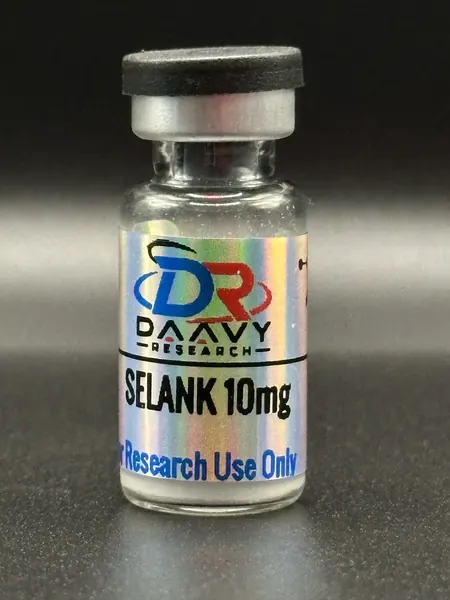
1. What Selank is
Selank is a synthetic heptapeptide with the sequence Thr-Lys-Pro-Arg-Pro-Gly-Pro, developed at the Institute of Molecular Genetics of the Russian Academy of Sciences. It is structurally based on tuftsin, a naturally occurring immunomodulatory tetrapeptide (Thr-Lys-Pro-Arg), with an added Pro-Gly-Pro sequence. It is supplied here as a lyophilized (freeze-dried) powder.
2. What published research has studied
Kolomin and colleagues, publishing in 2018, investigated the molecular mechanisms underlying Selank's anti-anxiety-related effects using radioligand receptor binding assays. The study reported that Selank acts as a positive allosteric modulator of [3H]GABA binding, and that its combined effect with certain benzodiazepines on GABA receptor activity was non-cumulative and distinct from either substance alone — leading the authors to propose a subtype-selective, concentration-dependent allosteric modulation mechanism. Notably for this page's purposes, the study's own methodology used RP-HPLC specifically to confirm the purity of the Selank used in the experiments, illustrating that analytical verification is treated as a prerequisite for the pharmacological research itself, not a separate concern.
A separate human study by Zozulya and colleagues compared Selank to the benzodiazepine medazepam in 62 patients diagnosed with generalized anxiety disorder (GAD) and neurasthenia (30 received Selank, 32 received medazepam), assessed with the Hamilton, Zung, and CGI psychometric scales. The study reported broadly similar anxiolytic effects between the two, with Selank additionally associated with anti-asthenic and psychostimulant effects, and correlated changes in serum leu-enkephalin activity. This trial is registered in the Russian clinical literature and indexed on PubMed; it has not been replicated in a large, blinded Western trial.
3. What this research does not establish
- The human evidence base is small and largely single-country. The Zozulya study and similar Selank clinical literature come from Russian research groups; no large, blinded, Western-run controlled trial has been published confirming these findings independently.
- Selank is not FDA-approved. It is registered as an anxiolytic in Russia, which is a distinct regulatory finding from FDA approval and does not establish safety or efficacy under US standards.
- The molecular mechanism study used animal-derived tissue and in vitro binding assays (rat brain plasmatic membranes), not human subjects — a mechanistic proposal, not a demonstrated human clinical pathway.
- Neither cited study evaluated the lyophilized powder form or long-term storage stability of Selank itself — see the stability section below for what published peptide stability research says more generally, since compound-specific, publicly available long-term stability data for Selank was not identified.
4. How purity and identity are actually verified
RP-HPLC purity analysis. Reversed-phase high-performance liquid chromatography separates a sample's components by hydrophobicity as they pass through a column, detected here at 214 nm (a wavelength that reliably detects the peptide bond itself, not just aromatic side chains). The main peak's area, expressed as a percentage of total peak area, is the reported purity figure. This is a relative, area-percentage measure — it does not by itself confirm the compound's identity, only how much of whatever is in the vial belongs to a single dominant peak versus impurities/related fragments.
LC-MS/MS identity confirmation. Liquid chromatography paired with tandem mass spectrometry separates the sample the same way, then measures the mass-to-charge ratio of ionized fragments. A reported [M+H]+ ion matching Selank's expected monoisotopic mass is what confirms identity — that the peptide backbone present is actually Selank's sequence, not merely something eluting at a similar retention time. Purity and identity are deliberately separate tests because a sample can have a clean, single HPLC peak that is nonetheless the wrong compound; only mass spectrometry can catch that.
5. What published stability data shows for lyophilized peptides
Compound-specific, publicly available long-term stability data for Selank was not identified for this page. What follows is general peptide stability methodology and data from the published/patent literature on other peptides, included because the underlying chemistry and testing approach transfers across most short synthetic peptides in lyophilized form.
A representative accelerated stability study on a different lyophilized peptide (the chloride salt of TAT-NR2B9c) illustrates the standard approach: samples were stored at multiple temperatures (5°C, 25°C, 40°C, and 60°C) and monitored over time by RP-HPLC for the growth of specific impurity peaks. At 40°C, one tracked impurity grew from 0.09% to 0.27% over one month; at 60°C, the same impurity grew from 0.09% to 0.59% over the same period, while no impurity was observed at −20°C. LC-MS/MS identified the impurities as acetylation products at the peptide's N-terminus and lysine side chains. Using the Arrhenius equation to extrapolate from the elevated-temperature data, the study projected under 0.5% impurity after 16 months at 25°C, or under 2% after many years at 5°C — the standard method for predicting long-term, real-temperature stability from faster, high-temperature testing.
The general pattern reported across published lyophilized-peptide stability research is that degradation is temperature-driven and roughly doubles with every 10°C increase, that properly lyophilized peptides stored cold show markedly slower degradation than the same peptide in reconstituted (dissolved) solution, and that moisture exposure is an independent risk factor alongside temperature. This is the general rationale behind storing lyophilized peptides cold and dry until reconstitution, and behind treating reconstituted solutions as having a much shorter usable window than the sealed lyophilized powder.
Sources
- Kolomin et al. (2018), "Peptide-based Anxiolytics: The Molecular Aspects of Heptapeptide Selank Biological Activity" — PubMed
- Zozulya et al., "Efficacy and Possible Mechanisms of Action of a New Peptide Anxiolytic Selank in the Therapy of Generalized Anxiety Disorders and Neurasthenia" — PubMed
- USPTO patent filing, "Chloride Salt of TAT-NR2B9c" — representative lyophilized peptide accelerated stability data (a different peptide, cited for methodology only, not for Selank-specific results)
Research-use disclaimer
This page summarizes published literature and standard analytical methodology for educational purposes. It has not been evaluated by the U.S. Food and Drug Administration. DAAVY Research supplies Selank only for legitimate laboratory, analytical, academic, or institutional research; it is not intended for human or veterinary use, consumption, diagnosis, treatment, or prevention. Nothing on this page is dosing, medical, or legal advice. See our complete research-use policy.