1. What Tesamorelin is
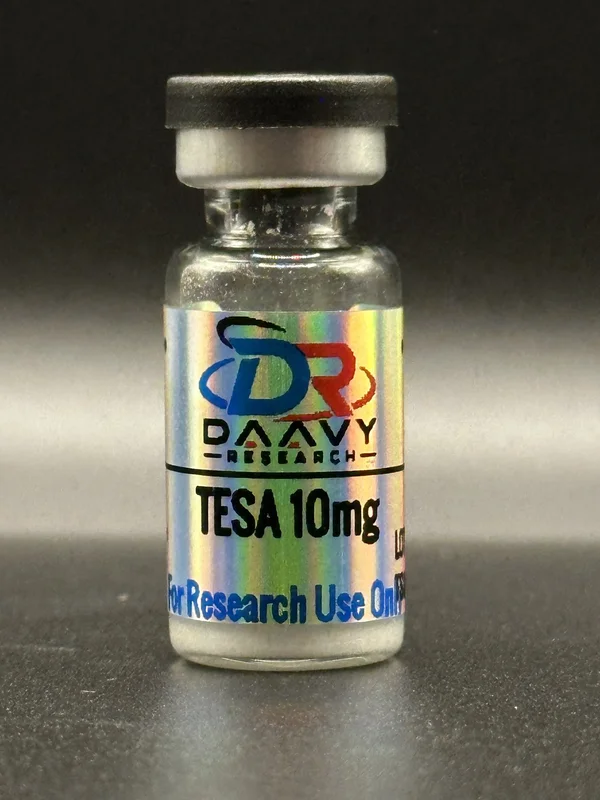
Tesamorelin is a synthetic 44-amino acid analog of growth-hormone-releasing hormone (GHRH). It is typically supplied here as a lyophilized (freeze-dried) powder for laboratory use, code-labeled by milligram amount. A tesamorelin formulation is separately marketed as an FDA-approved prescription drug for a specific, narrow indication (reduction of excess visceral fat in HIV-associated lipodystrophy); that approved pharmaceutical product is distinct from this unapproved research-material listing, and no claims of pharmaceutical equivalence, safety, or efficacy are made for this listing.
2. What clinical research has studied
A landmark 2007 randomized, double-blind, placebo-controlled trial published in the New England Journal of Medicine by Falutz and colleagues randomized 412 HIV-infected patients with abdominal fat accumulation to daily subcutaneous tesamorelin or placebo for 26 weeks. The trial reported a 15.2% decrease in visceral adipose tissue (measured by CT) in the tesamorelin group, compared with a 5.0% increase in the placebo group, along with improvements in triglycerides and the total cholesterol-to-HDL ratio.
A 2014 randomized, double-blind, placebo-controlled trial published in JAMA by Stanley, Feldpausch, and colleagues examined 50 HIV-infected patients over 6 months and reported that tesamorelin significantly reduced both visceral adipose tissue and liver fat relative to placebo, while noting that the clinical importance of the liver-fat finding required further study.
3. What this research does not establish
- Trials were conducted in a specific population — HIV-infected patients with abdominal fat accumulation — not in the general population, and findings should not be generalized beyond that studied group.
- This listing is not the approved pharmaceutical product. The clinical trials above evaluated a specific approved drug formulation and dosing regimen; this research-material listing has not been evaluated for identity to, or equivalence with, that product.
- No safety or efficacy claims apply to unsupervised or non-clinical use. The cited trials were conducted under clinical supervision with specific inclusion criteria, dosing, and monitoring.
4. What a Tesamorelin Certificate of Analysis verifies
Because Tesamorelin is a large (44-amino acid) synthetic peptide supplied as a lyophilized powder, the analytical questions a COA should answer are: does the vial contain the labeled peptide (identity, typically via LC-MS/MS), how much is present relative to the labeled amount (content, via HPLC quantitation), and how pure is the sample (overall purity, via RP-HPLC). See the Interactive COA Decoder for a field-by-field walkthrough and red-flag checklist, and the How to Read a COA guide for the fundamentals.
Sources
- Falutz J, Allas S, Blot K, et al. (2007), "Metabolic Effects of a Growth Hormone–Releasing Factor in Patients with HIV," New England Journal of Medicine 357(23):2359–2370
- Stanley TL, Feldpausch MN, Oh J, et al. (2014), "Effect of Tesamorelin on Visceral Fat and Liver Fat in HIV-Infected Patients With Abdominal Fat Accumulation: A Randomized Clinical Trial," JAMA 312(4):380–389
Research-use disclaimer
This page summarizes published literature for educational purposes. It has not been evaluated by the U.S. Food and Drug Administration. DAAVY Research supplies Tesamorelin only for legitimate laboratory, analytical, academic, or institutional research; it is not intended for human or veterinary use, consumption, diagnosis, treatment, or prevention. Nothing on this page is dosing, medical, or legal advice. See our complete research-use policy.