1. What GHK-Cu is
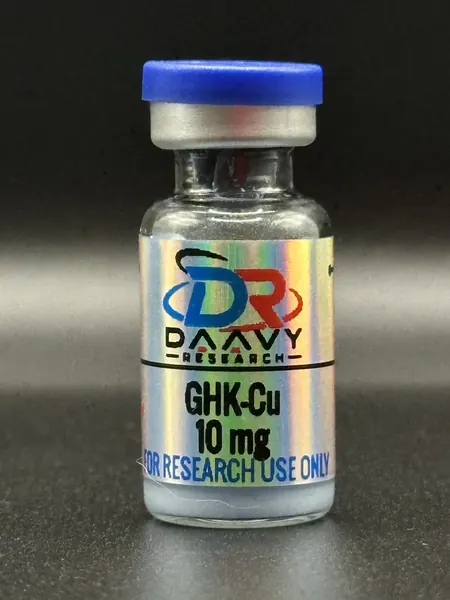
GHK-Cu is a naturally occurring copper-binding tripeptide — glycyl-L-histidyl-L-lysine bound to a copper(II) ion. It occurs naturally in human plasma, saliva, and urine, and its concentration has been reported to decline with age. GHK peptide fragments are released from type I collagen at sites of tissue injury, where they bind available copper ions to form the active GHK-Cu complex. It is typically supplied as a lyophilized (freeze-dried) powder for laboratory use, code-labeled by milligram amount.
2. What research has studied
A widely cited mechanistic review by Pickart and colleagues, published in the International Journal of Molecular Sciences/PMC literature, reported that GHK-Cu at very low, nontoxic concentrations (1–10 nanomolar) stimulated both synthesis and breakdown of collagen and glycosaminoglycans in laboratory models, and modulated the activity of matrix metalloproteinases and their inhibitors (TIMP-1 and TIMP-2) — a regulatory role described as central to wound healing and tissue remodeling processes. The same review noted that GHK-Cu has been shown to attract immune and endothelial cells to injury sites and, in a 2001 study, was reported to restore replicative capacity to fibroblasts damaged by radiation therapy.
Animal-model wound healing activity has been reported across several species. The Pickart review describes studies in which GHK-Cu accelerated wound healing and increased blood vessel formation and antioxidant enzyme levels in rabbits, supported systemic wound healing in rats, mice, and pigs, and improved healing of diabetic and ischemic wounds in rats while decreasing TNF-alpha levels and stimulating collagen synthesis.
A 2025 comprehensive review of tripeptides in wound healing, covering literature from 2016–2025, described GHK-based research as demonstrating stimulated fibroblast migration, enhanced collagen deposition, extracellular matrix remodeling, and antimicrobial and anti-inflammatory properties across the formulations studied. A separate 2025 comparative review of BPC-157 and GHK-Cu in wound healing noted that, unlike BPC-157, limited human trials have evaluated topical GHK-Cu formulations for skin-quality outcomes — a meaningfully different evidence base between the two compounds. As of 2026, at least one registered interventional study on ClinicalTrials.gov is evaluating a topical GHK-Cu gel against a vehicle control for small standardized skin wounds in healthy adults, with photographic wound assessment over three weeks.
3. What this research does not establish
- Most mechanistic evidence comes from cell-culture and animal models, not controlled human trials of injectable or systemic GHK-Cu.
- The human trial activity that does exist is topical and formulation-specific — evaluating a particular gel or delivery vehicle, not unformulated research-grade powder of the kind sold here.
- Delivery to target tissue remains a documented open question. Published methodological work has specifically noted that measuring how much GHK-Cu actually reaches target tissue from a given delivery system is still a limiting factor in translating lab findings to clinical outcomes.
- Animal- and cell-model findings do not automatically apply to humans or to different routes of administration.
4. What a GHK-Cu Certificate of Analysis verifies
Because GHK-Cu is supplied as a lyophilized powder, the analytical questions a COA should answer are: does the vial contain the labeled peptide-copper complex (identity, typically via LC-MS/MS), how much is present relative to the labeled amount (content, via HPLC quantitation), and how pure is the sample (overall purity, via RP-HPLC). See the Interactive COA Decoder for a field-by-field walkthrough and red-flag checklist, and the How to Read a COA guide for the fundamentals.
Sources
- Pickart et al., "GHK Peptide as a Natural Modulator of Multiple Cellular Pathways in Skin Regeneration" — PMC
- "Exploring the Role of Tripeptides in Wound Healing and Skin Regeneration: A Comprehensive Review" (2025), International Journal of Medical Sciences
- "BPC-157 and GHK-Cu in Wound Healing and Tissue Repair: A Review of Clinical Efficacy and Safety" (2025)
- ClinicalTrials.gov NCT07437586, "Topical GHK-Cu Gel for Acute Skin Wound Healing"
Research-use disclaimer
This page summarizes published research for educational purposes. It has not been evaluated by the U.S. Food and Drug Administration. DAAVY Research supplies GHK-Cu only for legitimate laboratory, analytical, academic, or institutional research; it is not intended for human or veterinary use, consumption, diagnosis, treatment, or prevention. DAAVY Research's product is not affiliated with, and has not been evaluated in, the third-party clinical trial referenced above. Nothing on this page is dosing, medical, or legal advice. See our complete research-use policy.