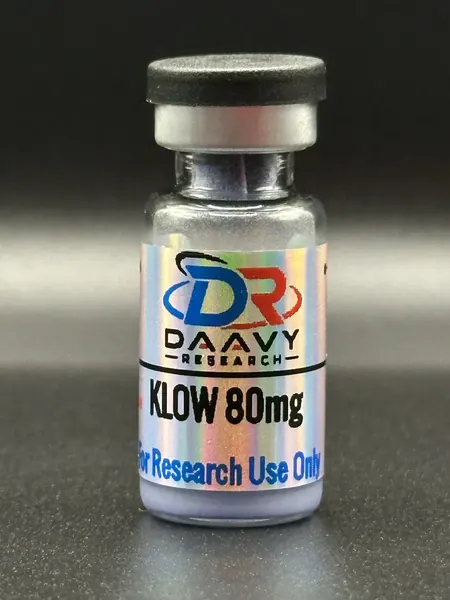
1. GHK-Cu (50 mg)
A copper-binding tripeptide studied for its role in collagen and glycosaminoglycan synthesis, matrix metalloproteinase regulation, and wound-healing models across several animal species. See the full GHK-Cu Research Overview for sourced detail, including its more developed human trial history relative to the other components here.
2. BPC-157 (10 mg)
A synthetic pentadecapeptide studied preclinically for angiogenesis, tendon and ligament healing, and gastroprotective pathways, with no completed controlled human trials as of the most recent systematic review. See the full BPC-157 Research Overview for sourced detail.
3. TB-500 (10 mg)
TB-500 is a synthetic 7-amino-acid fragment (Ac-LKKTETQ) corresponding to the actin-binding region of thymosin beta-4, a 43-amino-acid protein present in most mammalian cells. A 2003 study in the FASEB Journal by Philp and colleagues demonstrated that this actin-binding domain drives angiogenesis both in vitro and in vivo, and a 2010 review in the Annals of the New York Academy of Sciences by Crockford and colleagues described this region as the mechanistic core of the parent protein's tissue-repair activity.
An important distinction: published human clinical trial data for thymosin beta-4 — including Phase II and Phase III ophthalmic trials and a 2025 cardiac trial — has been conducted using the full-length 43-amino-acid protein, not the synthetic TB-500 fragment. As of the most recent literature reviewed, TB-500 specifically has no comparable human trial program; the evidence base for the fragment is preclinical. A 2024 study published in the Journal of Pharmaceutical and Biomedical Analysis further reported that TB-500's wound-healing activity observed in cell culture may originate from one of its breakdown metabolites (Ac-LKKTE) rather than from TB-500 itself — a finding that, if confirmed, would complicate straightforward interpretation of existing in vitro results.
4. KPV (10 mg)
KPV (Lysine-Proline-Valine) is a tripeptide corresponding to the C-terminal three residues of alpha-melanocyte-stimulating hormone (alpha-MSH), a 13-amino-acid peptide with documented anti-inflammatory activity. A 2003 study by Ichiyama and colleagues published via PubMed compared KPV to full alpha-MSH in a mouse model of crystal-induced peritonitis and found that while both reduced inflammatory cell accumulation, KPV's effect was not blocked by a melanocortin receptor 3/4 antagonist and, unlike alpha-MSH, KPV did not inhibit cytokine release from activated macrophages in vitro — indicating KPV's mechanism is not simply a smaller-scale copy of the parent hormone's pathway. A 2014 review by Singh and Mukhopadhyay described alpha-MSH and its C-terminal fragments, including KPV, as sharing anti-inflammatory and antimicrobial characteristics with other host-defense peptides, primarily through modulation of NF-κB signaling in laboratory models. DAAVY Research's current individually-sold KPV listing is at KPV 10 mg.
5. What this page does not establish
- No study has evaluated KLOW, or this four-peptide combination, as a formulation. Each peptide's research history above concerns that peptide in isolation.
- Evidence quality varies substantially by component. GHK-Cu has limited topical human trial history; BPC-157 and TB-500 (as opposed to full-length thymosin beta-4) have none; KPV's evidence is laboratory and animal-model based.
- Combining peptides does not imply combined or additive effects have been studied or demonstrated — that would require dedicated research this page does not cite because it does not exist.
6. What KLOW's Certificate of Analysis verifies
Because KLOW is a four-component blend, its COA needs to confirm identity and content for each labeled peptide individually, in addition to overall purity — not just a single-compound result. See the Interactive COA Decoder and the How to Read a COA guide for what to check.
Sources
- Ichiyama et al., "Dissection of the anti-inflammatory effect of the core and C-terminal (KPV) alpha-melanocyte-stimulating hormone peptides" — PubMed
- Singh & Mukhopadhyay (2014), "Alpha-Melanocyte Stimulating Hormone: An Emerging Anti-Inflammatory Antimicrobial Peptide" — PMC
- "TB-500 (Thymosin Beta-4): The Full Research Picture," summarizing the clinical vs. preclinical evidence distinction
- DAAVY Research Academy: GHK-Cu Research Overview (full source list)
- DAAVY Research Academy: BPC-157 Research Overview (full source list)
Research-use disclaimer
This page summarizes published research on each named peptide independently for educational purposes; it does not attribute any finding to the KLOW blend as a combined formulation. It has not been evaluated by the U.S. Food and Drug Administration. DAAVY Research supplies KLOW only for legitimate laboratory, analytical, academic, or institutional research; it is not intended for human or veterinary use, consumption, diagnosis, treatment, or prevention. Nothing on this page is dosing, medical, or legal advice. See our complete research-use policy.